
Hope for Housing
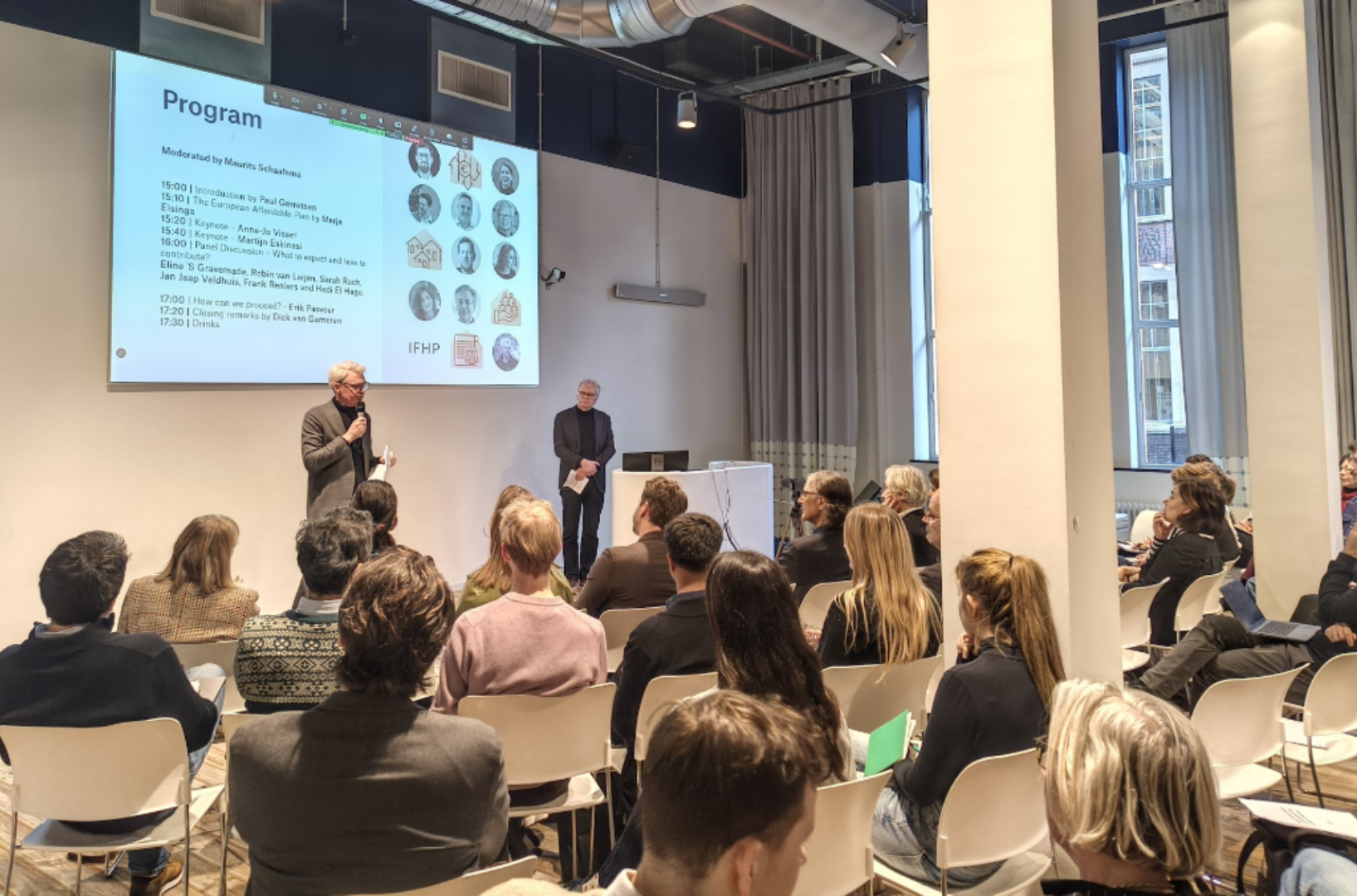
On 21 January 2026, International Federation for Housing and Planning (IFHP) and Vereniging Deltametropool (VDM) hosted a public dialogue titled “Hope for Housing? The European Affordable Housing Plan” at the Faculty of Architecture, TU Delft. The session brought together researchers, practitioners, policymakers, and housing professionals to examine how Europe’s new housing agenda can translate into Dutch political and spatial planning practice.
This article captures the key themes and discussions from the event. It builds on the “Our Plea” submitted to the European Commission’s Housing Task Force in May 2025, following the Brussels Convening, and reflects the continuing journey of this network towards a meaningful European Housing Agenda.
Housing should be treated as a system embedded in wider territorial dynamics. This means linking it with spatial planning, labour markets, mobility, and social cohesion. Europe faces deeply interconnected spatial challenges: urbanisation, demographic change, and housing shortages. These cannot be addressed at national or project scale alone. Hope for Housing dialogue served as a continuation of that discussion, focusing on the recently launched European housing initiatives and the practical realities of housing delivery in cities and regions.
Key Takeaways
1. Housing enters the European agenda
Housing has historically been considered primarily a national competence within the European Union. However, recent political developments indicate a growing recognition of housing as a matter of European concern. In particular, the European Commission has begun to frame housing as a key factor for social cohesion, economic competitiveness and sustainability, highlighting its importance for Europe’s future. The launch of the European Affordable Housing Plan, presented as part of a broader housing package, signals a new step in this direction. The plan outlines four main pillars:
boosting housing supply
mobilising investment
providing immediate support for those most affected
preparing structural reforms for the future
2. The European Affordable Housing Plan: Ambitions and Gaps
While the initiative is widely welcomed as an important political signal, speakers stressed that it represents only a starting point. The effectiveness of the plan will depend on implementation at national, regional and local levels, where housing policy instruments are primarily located. Among the most significant observations:
Spatial planning was largely absent from the final plan, despite many recommendations from the Housing Advisory Board explicitly linking housing to planning. Spatial planning remains a member state competence, but participants stressed this cannot be a reason to ignore the relationship.
The state aid revision (including the ATAD directive) was widely welcomed as the most concrete and impactful element for the Netherlands, where housing associations are estimated to lose over €400 million per year in investment capacity to a directive originally designed to combat international tax evasion — not social housing.
Questions were raised about whether the “new money” promised in the plan is genuinely new or a relabelling of existing cohesion funds.
Social segregation, spatial inclusion, and anti-gentrification measures — strongly emphasised in the Housing Advisory Board recommendations — did not land in the final plan, a gap that multiple participants flagged as a significant concern.
Short-term rentals (Airbnb) and housing speculation were identified as needing stronger EU-level regulatory tools, particularly for southern European cities.
3. The Dutch reality: crisis at scale
Speakers from the Amsterdam housing association sector and the Ministry of Housing and Spatial Planning painted a picture of a serious and multidimensional crisis. In Amsterdam alone, 140,000 people applied for a social housing unit last year, while only 8,900 became available. Average waiting times have fallen from 13 to 10 years but remain deeply problematic. Key bottlenecks were identified by practitioners:
Supply and construction constraints: A severe shortage of skilled construction workers limits the pace of development and renovation. Rising construction costs — approximately 6% per year — compound this pressure. Available building locations and land remain scarce.
Infrastructure and grid limitations: Electricity grid congestion is blocking new connections and delaying housing projects. Infrastructure constraints are becoming a structural bottleneck, not an exception.
Regulatory and procedural delays: The new Environment and Planning Act has introduced permitting delays. Regulatory complexity continues to slow construction timelines significantly.
Financial pressures on housing associations: Housing associations are investing heavily in new supply. Yet rising tax burdens and non-cost-based rent structures create tension. Balancing affordability with long-term investment capacity is increasingly difficult. Insufficient financial capacity means sustainability retrofits must compete with new build investment.
In response, housing sector continue to invest significantly in new construction and housing improvements, including industrialized building methods, bio-based insulation strategies, and neighbourhood-based housing developments. The discussion pointed to genuine innovation: modular and prefabricated construction at scale, bio-based insulation materials, and housing mobility schemes encouraging elderly residents to downsize to free up larger homes for families.
4. The Planning-Housing Disconnect
The discussion emphasised that while the European Union can support housing policy through funding mechanisms, regulatory frameworks and coordination, housing itself remains primarily the responsibility of member states. A recurring theme throughout the event echoed the arguments of the earlier Brussels plea: housing challenges cannot be addressed through isolated building projects alone. Instead, participants stressed the need to reconnect housing policy with spatial planning and territorial development, ensuring that housing supply aligns with employment, infrastructure and social services.
A recurring theme was the disconnect between housing numbers targets and integrated spatial planning. Several participants noted that pressure from national government to deliver housing targets – numbers, numbers, numbers, risks losing sight of what good cities require: proximity to work, transport, education, green space, and social infrastructure. One speaker noted that the Netherlands spent €7.5 billion on infrastructure in recent years, while annual healthcare costs have reached €190 billion. Building well now, with health and community in mind, is not just a social argument but an economic one.
The European Commission’s representative at the event acknowledged the tension: spatial planning remains a national and local competence, and rightly so. However, participants argued that the Housing Alliance, an emerging EU platform for knowledge sharing, should firmly put spatial and qualitative dimensions of housing on its agenda.
5. Housing as a systemic and spatial issue – Financialisation Challenge
The discussions highlighted the importance of focusing not only on new construction but also on renovation, regeneration and the better use of existing housing stock, reflecting a broader shift toward more sustainable and circular housing strategies. Erik Pasveer, speaking on behalf of the IFHP Board in his closing remarks, identified the privatisation and financialisation of housing as the central obstacle to affordable and accessible housing today. He observed that a sector described as being in crisis nonetheless generates substantial profit, and that any serious attempt to address the housing crisis must include a macro-economic perspective and make housing a public responsibility once more. This framing resonated across the discussion, connecting to the call in “Our Plea” to advocate for open dialogue on public instruments and anti-speculation and to establish mechanisms that retain capital within the housing system itself.
6. Towards continued dialogue
The event reaffirmed the spirit of “Our Plea”: that a European Housing Agenda must align EU ambitions with the territorial realities of its diverse regions. Planners, designers, researchers, tenants, and policymakers must work together, across borders and institutions, to make the hope for housing a reality. Participants emphasised the importance of combining policy frameworks with practical experience from cities and housing organisations. The dialogue concluded with four priorities to guide the network’s work ahead.
First, to start with urgency, centring those for whom decent housing remains furthest out of reach: young people, students, labour migrants, starters on the housing market, and communities in left-behind areas.
Second, to connect the agendas, linking the European Housing Plan to broader EU strategies, including the Draghi report, the Competitiveness Compass, and goals around climate, mobility, and public health. Good housing and urban planning, as participants underlined, is a precondition for labour productivity and innovation.
Third, to learn by exchanging, building new partnerships across Europe and mobilising the IFHP network to share best practices through platforms for cross-border learning.
Fourth, to build pipelines from policy to projects, collectively translating regulations, procedures, and programmes into real improvements in housing conditions across cities and villages in Europe.
TU Delft offered further collaboration, affirming the relevance of this work for both research and education. The dialogue Hope for Housing event is not a conclusion, but an ongoing process. It aims to shape a European approach to housing that remains grounded in local realities while addressing shared continental challenges. A follow-up event is proposed for approximately six months.
The report has been developed by IFHP. For any queries, please reach out to info@ifhp.org
Watch the session back:
A special thanks goes to our speakers; Marja Elsinga (TU Delft) , Marja Elsinga (TU Delft), Martijn Eskinasi (Ministry of Housing and Spatial Planning), panel members; Robin van Leijen (AEDES/ Housing Europe), Sarah Rach (The Hague), Jan Jaap Veldhuis (IPO) and Hadi El Hage (European Cultural Centre), reactors; Esther Agricola (BPD), Erik Pasveer (Amsterdam) and Dick van Gameren (TU Delft/Mecanno), moderators, Maurits Schaafsma (Haarlemmermeer/ IFHP) and hosts for sharing their expertise and experiences.