
Connecting housing and planning in practice
Let’s explore the existing international examples that illustrate the relationship between housing and planning. These thought-provoking cases are directly linked to our OPEN CALL, in which we kindly invite you to share with us examples that you are familiar with. Below you can get to know a range of case studies that demonstrate how spatial planning shapes entire neighbourhoods and produces measurable social, economic, and environmental outcomes.
How Vienna uses zoning to keep housing affordable?

Seestadt Aspern, where large number of apartments is subsidized
Source: https://www.gehlpeople.com/projects/aspern-seestadt/
As housing costs continue to rise across European cities, Vienna has adopted an innovative planning tool to preserve affordability and limit land speculation.
In November 2018, the city introduced the ‘Subsidized Housing’ zoning category as part of an amendment to the Vienna Building Code. Under this regulation, developments within designated areas must allocate at least two-thirds of their residential floor space to subsidized housing. The policy aims to ensure a continued supply of affordable homes while fostering social mix across the city.
The zoning category is primarily applied when industrial or commercial land is converted to residential use, but it can also be used in higher-density and high-rise developments. Importantly, the regulation only applies to projects providing more than 5,000 m² of residential floor space, allowing the city to target larger developments with significant market impact.
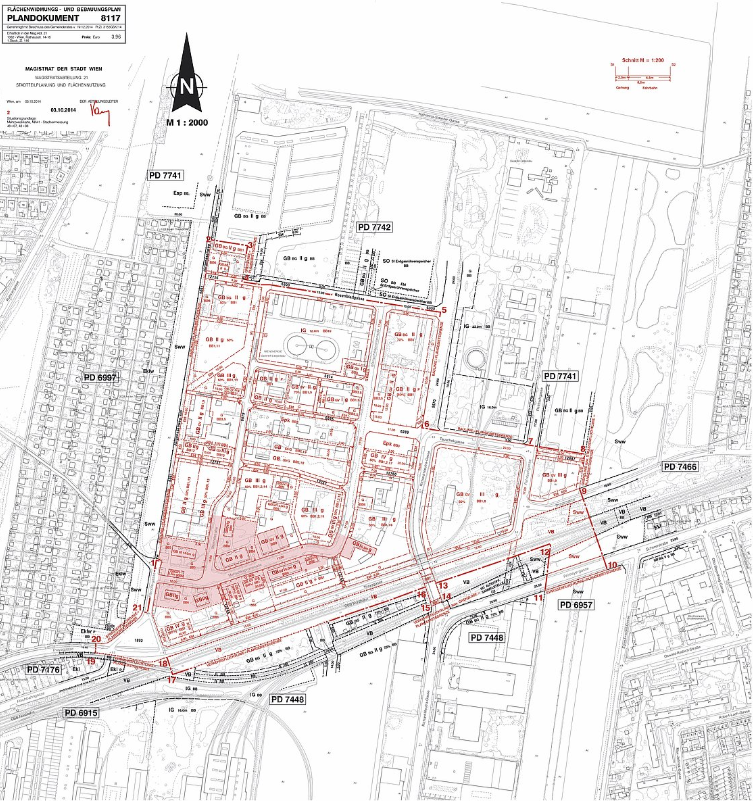
Vienna zoning and development plan
Source: https://socialhousing.wien/tools/urban-development-and-land-policy
One notable example is the continued development of Seestadt Aspern, one of Europe's largest urban development projects. A large number of apartments is subsidized. The development contains residential units alongside community and commercial facilities, reflecting Vienna's integrated approach to urban development and housing provision.
Vienna's approach demonstrates how spatial planning and land-use regulation can be leveraged not only to shape urban growth but also to achieve long-term housing policy objectives.
Source: Social Housing Vienna. (n.d.). Urban development and land policy. City of Vienna. https://socialhousing.wien/tools/urban-development-and-land-policy
Are Accessory Dwelling Units (ADU's) the future of housing in California?
California's ADU (Accessory Dwelling Unit) programme was significantly developed in 2016 by the California Department of Housing and Community Development (HCD), even though the process was present even in the 1980s. Accessory dwelling units, also known as casitas or granny flats, are homes that share a parcel with an existing residence, typically a single-family home. ADUs can be either attached to or detached from the existing structure. They are commonly built out of existing garages.
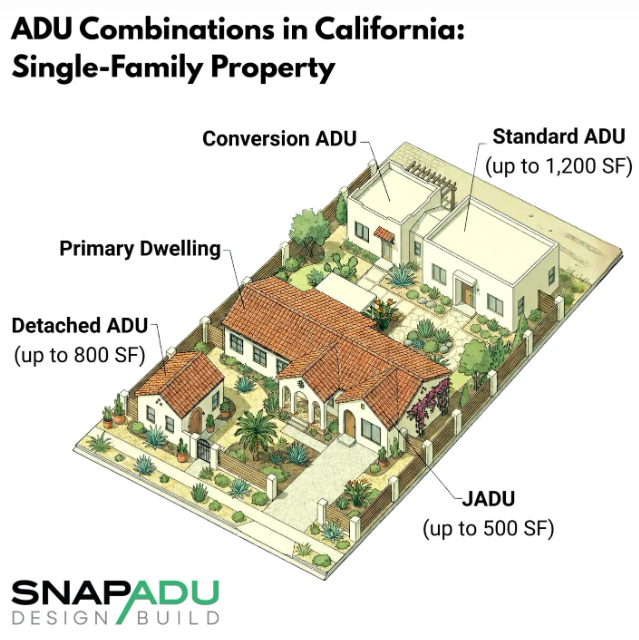
ADU Combinations in California
Source: https://snapadu.com/blog/how-many-adus-can-i-build-on-my-property-single-family-california/
California's latest ADU and zoning reforms highlight the powerful connection between housing policy and spatial planning. Rather than relying solely on large-scale developments, the reforms allow additional homes through accessory dwelling units, lot splits, and more flexible residential zoning rules.
What makes this approach particularly interesting is its focus on gentle density. Planning regulations determine how dense a neighbourhood can be, how plots can be subdivided, and what types of housing are permitted within different zones. By adjusting these rules, cities can unlock substantial housing capacity while preserving the character, scale, and atmosphere of existing neighbourhoods.
Therefore, ADU permits in California increased by more than 8 % from 80 in 2016 to 7,160 in 2022. As of 2022, nearly one in five new homes (19%) produced in the state was an ADU.
Therefore, zoning is not merely a technical planning tool, it is a housing affordability tool. Thoughtful land-use reform can increase supply, support affordability, and create more housing opportunities without sacrificing a neighbourhood's sense of place.
Sources: CCS Inc. Construction Consulting Services. (2026). Complete Guide to California's 2026 ADU Laws: AB 462, AB 1154, SB 9, and SB 543 Explained. Retrieved August 26, 2026, https://www.laconstructioncompliance.com/california-2026-adu-laws-ab-462-ab-1154-sb-9-sb-543-guide/
Gray, M. N. (2024). California ADU reform: A retrospective. How YIMBYs helped kick off a California building boom. California YIMBY. https://cayimby.org/wp-content/uploads/2024/01/CAY-ADU_Report-2024-v4.pdf
How does Finland's MAL model link housing, transport, and planning?

Pasila - one of the fastest developing districts in Helsinki, Finland
Source: https://avainasunnot.fi/myytavien-asuntojen-asuinalueet/pasila/
Through its MAL agreements (Land Use, Housing and Transport) since 2011, Finland links infrastructure funding directly to spatial planning decisions. The municipalities in urban regions are expected jointly to draft MAL plans, which are mainly non-statutory plans for land-use, housing, and transportation. Contracts cover a 12-year period, updated every 4 years (parliament term).
What makes this approach particularly compelling is its regional scale. The agreements cover seven major urban regions: Helsinki, Tampere, Turku, Oulu, Jyväskylä, Kuopio, and Lahti, representing 62 municipalities and approximately 55% of Finland's population. This approach relies on financial incentives rather than sanctions. The central government agrees to provide funding for projects such as transportation infrastructure, while municipalities commit to planning a specified number of housing units in areas that are well served by public transport.
From a spatial planning perspective, the MAL model goes beyond infrastructure delivery. The agreements include housing production targets, land-use objectives, zoning measures, and transport network investments, all coordinated through a long-term framework. The interests of the state and local governments are aligned through cooperation aimed at identifying shared objectives and developing measures to achieve them.
As a result, transport infrastructure becomes more than a mobility project. It shapes where housing is built, influences development patterns, and supports higher housing supply in well-connected locations. The Finnish example demonstrates that planning regulations and housing policy are most effective when they work together, guiding growth towards places where people can both live and move efficiently.
Sources: United Nations Economic Commission for Europe (UNECE). (2021). #Housing2030: Effective policies for affordable housing in the UNECE region. United Nations. https://unece.org/housing-and-land-management/publications/housing2030-study-e
Seppälä, A.-L. (2025, May 27). Land use, housing and transport agreements (MAL-agreements) [Presentation]. Ministry of the Environment, Finland. https://www.agri.ee/sites/default/files/documents/2025-05/Anna-Leena%20Sepp%C3%A4l%C3%A4.pdf
Can planning flexibility help Ukraine build back better?

War-torn traditional Ukrainian house
Source: https://www.kyivpost.com/post/15292
Ukraine’s post-war reconstruction is not only a housing challenge, but also a planning challenge. In August 2025, the Ukrainian Parliament adopted Law No. 4321-XI, extending the use of Detailed Plans of Territory (DPTs) for zoning decisions until 1 January 2028. This amendment to the Law “On Regulation of Urban Development Activity” (Law No. 3038-VI), the country’s primary planning framework, provides municipalities and developers with greater flexibility at a time when rebuilding cannot wait.
The scale of destruction caused by Russia’s invasion requires housing to be delivered quickly, affordably, and accessibly so that displaced residents can return to their communities. In this context, planning regulations become critical instruments of recovery. Under normal circumstances, zoning decisions are expected to derive from comprehensive spatial development plans, master plans, and other higher-level planning documents. However, many municipalities, particularly those affected by the war, have not yet completed these plans. By extending the use of DPTs, local authorities can continue making zoning decisions and issuing development permissions through more detailed planning documents, accelerating reconstruction.
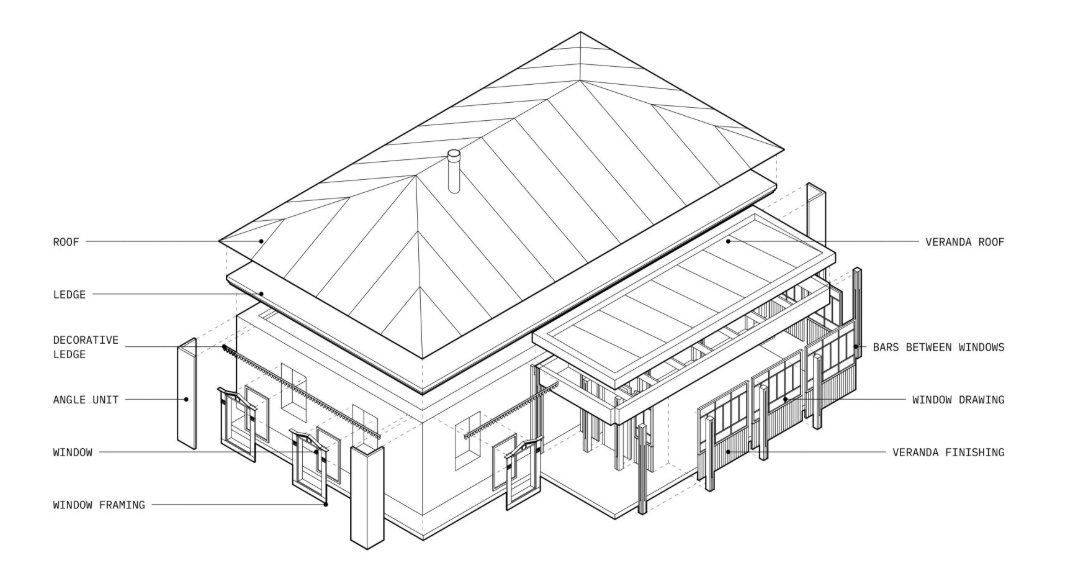
Online toolkit to help homeowners rebuild their war-damaged properties, by Balbek Bureau
Source: https://www.architectsjournal.co.uk/news/kyiv-architect-creates-online-self-help-kit-for-rebuilding-ukraine-homes
Importantly, this planning mechanism is relevant not only for post-war recovery but also for rebuilding after other catastrophic events such as floods, earthquakes, or major natural disasters. In such situations, the ability to streamline planning and development approvals can significantly speed up the delivery of housing and essential infrastructure while maintaining a strategic planning framework.
This is a compelling example of the relationship between housing and planning: regulatory flexibility can directly influence how quickly people regain access to safe homes. Yet reconstruction should not simply recreate what existed before. It presents a unique opportunity to build more resilient, sustainable, and better-planned communities. Alongside legislative reforms, innovative initiatives are emerging from practice.
Sources: CMS Ukraine. (2025, September 25). Ukraine extends use of detailed plans of territory for zoning decisions. CMS Law. https://cms.law/en/ukr/legal-updates/ukraine-extends-use-of-detailed-plans-of-territory-for-zoning-decisions
Food and Agriculture Organization of the United Nations. (2023, December 8). Law No. 3038-VI “On Regulation of City Planning Activity.” FAOLEX, UNEP Law and Environment Assistance Platform. https://leap.unep.org/en/countries/ua/national-legislation/law-no-3038-vi-regulation-city-planning-activity
How did KIP transform Jakarta's kampungs?

New pathways due to Kampung Improvement programme in Jakarta
The Kampung Improvement Program (KIP), launched in Jakarta in 1969, is widely recognized as one of the earliest large-scale examples of using neighborhood upgrading to improve housing conditions in informal settlements. Rather than clearing low-income communities, the programme focused on enhancing existing neighborhoods through targeted spatial and infrastructure interventions.
The programme invested in roads, footpaths, drainage systems, drinking water facilities, sanitation, waste collection, schools, and health clinics, helping to improve living conditions and reduce environmental risks. By upgrading infrastructure within existing neighborhoods, KIP strengthened housing quality and resilience while allowing residents to remain in their communities. Improved services and accessibility also encouraged households to invest in upgrading their own homes.
A key factor in the programme's expansion was financial support from the World Bank, which enabled KIP to grow beyond Jakarta from 1974 onwards. The programme was subsequently implemented in more than 800 cities across Indonesia, benefiting an estimated 30 million people. Its success demonstrates how spatial planning, infrastructure provision, and targeted public investment can improve housing security and urban resilience without large-scale displacement.
Although KIP is no longer implemented in its original form, its principles continue to influence urban upgrading in Jakarta. A recent example is the “village surgery” programme, which aims to upgrade 250 slum neighborhood units by 2026 through improvements to drainage, sanitation, road access, and the residential environment. Funded through local government budgets and CSR contributions, the programme demonstrates the continued relevance of KIP's participatory and infrastructure-led approach to creating inclusive and sustainable communities
Source: Pathfinders for Peaceful, Just and Inclusive Societies. (2024, June 13). Kampung neighborhood upgrades: Indonesia. https://www.sdg16.plus/policies/kampung-neighborhood-upgrades-indonesia/
Perkim.id. (2025, September 4). Mengenal lebih dekat Kampung Improvement Program. https://perkim.id/kumuh/mengenal-lebih-dekat-kampung-improvement-program/
How does Thailand's Baan Mankong programme tackle informal settlements?
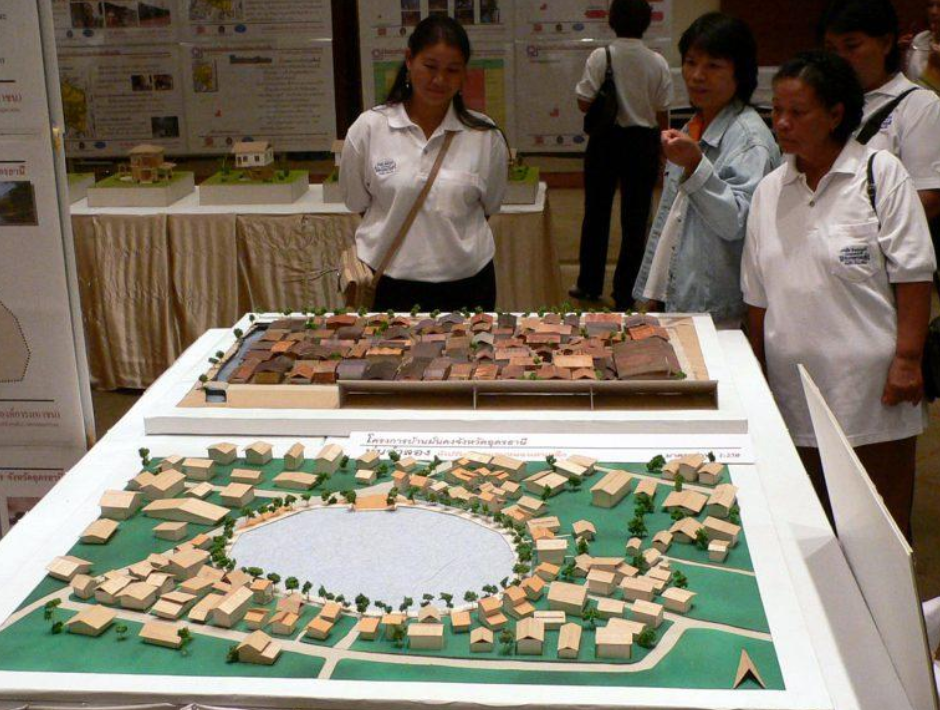
Local community meeting, Baan Mankong, Thailand
The Community Organizations Development Institute (CODI)'s Baan Mankong ("Secure Housing") programme, launched in 2003, was created to tackle the challenge of informal settlements across Thailand. Rather than relying on top-down housing delivery, the programme provides infrastructure subsidies and low-interest loans to community cooperatives, enabling residents to plan and upgrade their neighbourhoods themselves. Between 2003 and 2011, it improved housing and living conditions for more than 90,000 households in 1,546 communities nationwide.
What makes the programme particularly relevant for spatial planning is its city-wide approach to informal settlements. Communities work with local authorities to survey and map all low-income settlements in a city, identify land for upgrading or redevelopment, and negotiate solutions such as land sharing, long-term leases, or relocation where necessary. Rather than treating housing as an isolated project, Baan Mankong integrates housing with roads, drainage, sanitation, and public space improvements. Many settlements are redesigned into denser row-house or low-rise apartment developments, enabling more households to live on serviced land while reducing pressure for further informal expansion.
The programme's success is underpinned by a collective finance model. To participate, residents must form savings groups and register as cooperatives, allowing households with limited assets or irregular incomes to access affordable housing finance. Loans are issued to the cooperative rather than individual households, creating shared responsibility for repayment and strengthening community support networks. Government-backed loans and community reserve funds help manage financial risks, while a requirement to retain community control of land for at least 15 years reduces speculation, prevents displacement, and helps ensure that upgraded neighbourhoods remain affordable to their original residents.
The Thai experience demonstrates that tackling slums is not only a housing challenge but also a spatial planning challenge. By combining land-use planning, densification, infrastructure investment, and community finance within a single framework, the Baan Mankong programme has helped create more inclusive and resilient urban development.
Sources:
World Resources Institute. (2016, May 12). What Can We Learn from Thailand's Inclusive Approach to Upgrading Informal Settlements? https://www.wri.org/insights/what-can-we-learn-thailands-inclusive-approach-upgrading-informal-settlements
Community Organizations Development Institute (CODI). (n.d.). Baan Mankong Urban. https://en.codi.or.th/baan-mankong-urban/