
Connecting Housing and Planning

Figure 1
City of Almere as an experiment of living and welcoming everyone.
On the right, catalogue houses. On the left, houses designed by architecture studio, incorporating the needs of many families and creating a community.
Source: Author’s photos
The International Federation for Housing and Planning believes that housing and spatial planning are inseparable. Housing determines where and how people live, while spatial planning determines access to jobs, transport, services, green spaces, and opportunities. Addressing today’s housing crisis therefore requires housing policy and spatial planning to be developed together, an integrated approach rather than separate policy fields. For IFHP, the housing crisis is therefore not only a question of how many homes are built, but where, for whom, under what conditions, and how housing connects to the wider city. All around the globe we can see demand outreaching supply for affordable housing, with 318 million homeless people. ‘The global housing crisis is no longer just about housing – it is a wake-up call for action’ (UN, Habitat, 2024).
An appropriate urban planning action towards housing crisis is especially vital to approach nowadays, when more than 2.8 billion people struggle with housing inadequacy and about 1.1 billion people live in slums and informal settlements (SDG, Report, 2024). Although cities occupy only 3% of the world's land area, they are the places where rapid urban planning interventions can effectively transform the housing paradigm (Figure 1). Even though a political shift is already happening, for example a newly established special Committee on the Housing Crisis in the European Union (HOUS) and the European Affordable Housing Plan, a regulatory level and national-level reforms need to be connected to neighborhood realities and lived experience, where housing is not seen as a commodity, but rather as a human right (OHCHR, 2019).
Money shapes housing outcomes as much as regulation does. Homes are expensive to build and expensive to finance, and both have become more so. Construction costs, borrowing costs and land prices have risen together, while municipal budgets for infrastructure and planning capacity have not. At the same time, housing is increasingly treated as an asset class rather than a place to live. Homes are bought to store value, and this changes what gets built, where, and for whom. When housing is valued mainly as an investment, the distance grows between what the market delivers and what people need, and spatial planning becomes one of the few public instruments still able to influence the result. Any serious discussion of housing and planning therefore has to ask who pays, who profits, and who carries the risk.
Planning systems
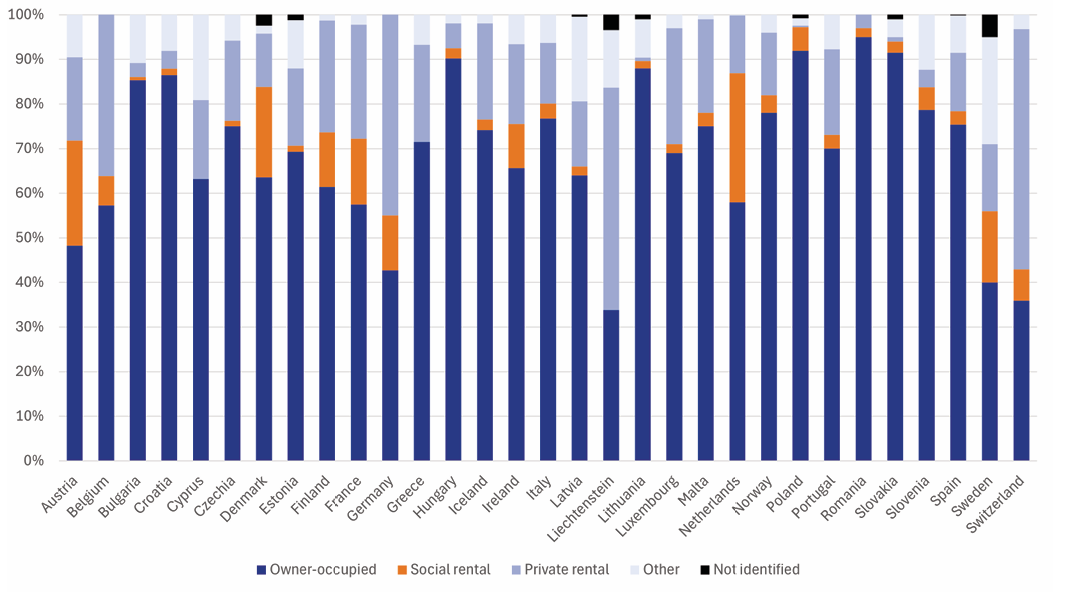
Figure 2
Tenure strucure
Source: ESPON, European Compendium of Housing Policies, 2025
Planning systems differ considerably between countries, reflecting different institutional structures, cultures, histories, and local needs. International collaboration should therefore not aim to standardize planning systems, but to understand what works, where, why, and under which conditions. A stronger international evidence base can connect local experiences, identify transferable lessons, and reveal how individual housing and planning decisions contribute to wider global challenges. This is where IFHP can make a distinctive contribution. IFHP sees its role as an international platform connectinghousing, planning, research, policy, and practice. By bringing together experiences across cities and countries, IFHP can make a distinctive contribution, IFHP can help translate local lessons into shared knowledge while recognizing that solutions must remain context sensitive.
Our role is not to promote a single planning model, but to create conditions for cities, practitioners, researchers, and policymakers to learn from one another, compare approaches, and develop better responses to common housing challenges. Improving land-use regulations can have significant positive effects on society and the economy. Greater flexibility in land-use planning can, where appropriate, enable housing supply to respond more effectively to demand, support access to productive urban areas, and contribute to investment and economic opportunity. This economic argument does not sit comfortably beside the human rights framing above, and it would be dishonest to present them as the same idea. One view holds that restrictive regulation is itself a main cause of scarcity, and that loosening it lets supply follow demand. The other holds that supply released without conditions flows to the most profitable locations and price points, not the most needed ones. Both positions are supported by evidence in different contexts. IFHP does not treat one as cancelling the other; the more useful question is under what conditions of regulatory flexibility and the right to adequate housing pull in the same direction. However, significant knowledge gaps remain:
‘The lack of internationally comparable data on local land-use regulations holds back understanding of their impact on housing outcomes’ (OECD, Brick by brick Building better housing policies, 2021).
Land-use regulations comprise complex qualitative, quantitative, and spatial rules, often allowing significant discretion in decision-making. One common characteristic across many OECD countries, land-use planning is largely managed by subnational authorities, particularly local governments. This makes international comparison challenging, but also valuable. In this context, a stronger international evidence base can help policymakers better understand the effects of land-use regulations and support more informed, effective housing and spatial planning decisions.
Housing as a right
International human rights instruments, beginning with the Universal Declaration of Human Rights and the International Covenant on Economic, Social and Cultural Rights, establish adequate housing as an integral component of a decent standard of living. Since then, international human rights agreements have continued to recognize adequate housing 4). and associated rights, including protection of the home and respect for privacy (UNHR, Right to Adequate Housing, 2014).
The right to adequate housing should not be mistaken for the right to land or property. Spatial planning nevertheless has considerable influence over whether adequate housing can be realized in practice, because it chapes where housing can be developed, at what density, in which forms, and in relation to which services, infrastructure, public spaces, and opportunities.
Housing rights and planning decisions therefore intersect at the neighborhood and city scale. The availability of a dwelling alone is insufficient if residents are disconnected from employment, education, public transport, healthcare, green space, or social infrastructure.
Housing sector in the planning system
There is considerable housing potential within the existing urban fabric that conventional planning approaches can overlook. Housing capacity is not created only through new development on vacant land. It can also emerge through the reuse and transformation of existing buildings and neighborhoods.
Possible housing may exist within vacant or underused homes, second homes, investment properties, empty office, or commercial buildings, and housing stock affected by demographic change (ESPON, European Compendium of Housing Policies, 2025). Planning for Housing therefore requires looking beyond two-dimensional land-use maps towards the existing building stock, changing demographics, evolving household structures, and new ways of living. This opens possibilities for adaptive reuse, conversion, subdivision, densification, and alternative housing models.
These possibilities include co-housing, community land trusts, housing cooperatives, adaptive reuse, and other collective or non-market housing models, which can provide more affordable access to building while also supporting community-building (Housing Europe, The state of housing in Europe, 2025).
Social rental housing is more common in some European countries than in others but still is mainly in the 3rd place behind owner-occupied and private rental (Figure 2). If this was to change, there would be more possibilities for community dwellings schemes and more affordable opportunities.
Where integration breaks down
There is broad agreement among practitioners that housing and planning should be integrated. The difficulty is rarely the principle. It is the conditions under which people work. Housing budgets and planning powers often sit in different departments, with different mandates, different funding cycles, and different political reporting lines. Coordination depends on individuals rather than on structures.
Planning departments in many countries have lost staff over the past fifteen years. Permit backlogs are frequently a capacity problem before they are a regulatory one, and no amount of regulatory reform removes the need for someone to assess an application.
Technical standards can block reuse even where policy supports it. The conversion of offices to housing commonly fails on fire escape requirements, daylight rules, floor-to-ceiling heights, or acoustic separation, rather than on the zoning map.
Detailed rules accumulate without review. Requirements on mailbox placement, corridor heating, or the number of power sockets rarely determine whether a home is adequate, but they add cost, time and uncertainty. Few systems have a process for asking whether such rules still earn their place.
Participation is asymmetric. The people who would benefit from new housing in a neighborhood do not yet live there and cannot object or vote. The people who may lose from it already live there and can do both. This is not an argument against consultation, but it explains why local processes tend to produce less housing than local needs suggest
These are not arguments for or against regulation. They are the conditions in which planning decisions are actually made, and any international comparison that ignores them will compare rules on paper rather than outcomes on the ground.
Historical context

Figure 3
Garden City diagram, Ebenezer Howard
Source: Circulation Network design in urban planning using Multi-Agent system A literature review and case study - Scientific Figure on ResearchGate, https://www.researchgate.net/figure/Ebenezer-Howard-Garden-City-model-1898_fig1_307138728
Although the spatial crisis is often regarded as a contemporary challenge, it is not an unprecedented phenomenon. In the 1850s and 1860s, Paris was redesigned by Georges-Eugène Haussmann to address overcrowding and improve public well-being through boulevards, green spaces and view corridors. In the 20th century, Camillo Sitte’s influence in Vienna was instrumental in shifting towards incorporating artistic principles into city design. In the early twentieth century, Ebenezer Howard introduced the Garden City model (Figure 3), which aimed to combine the benefits of urban and rural environments as a response to the challenges brought about by industrialization. Then, cities were also fighting with overcrowding, poor housing quality, pollution, congestion, and social inequality. Each of the solutions presented had a clear goal: to solve urban crises.
Each also carried a cost. Haussmann's boulevards improved sanitation, light and movement, but cleared dense working-class quarters and pushed poorer Parisians to the periphery, solving a public health crisis while producing a displacement crisis. Sitte's attention to artistic and human-scale design improved the quality of public space but said little about who could afford to live around it. Howard's Garden City produced healthier settlements, yet most built versions were low-density and selectively occupied, and the land-value capture mechanism intended to fund them was rarely applied. The pattern is consistent: ambitious planning tends to succeed on the problem it targets and to create new problems elsewhere, usually for the people with the least influence over the plan.
The widespread destruction caused by World War II left many cities in ruins, prompting a fundamental debate on post-war reconstruction and urban development. Today, Europe faces a similar challenge in supporting the reconstruction of Ukrainian cities and settlements affected by war. Beyond rebuilding physical infrastructure and housing, this process requires thoughtful spatial planning aimed at creating inclusive, resilient, and sustainable communities (ENHR).
The task today is not to reproduce historical models, but to learn from them while developing approaches suited to contemporary challenges: affordability, inequality, demographic change, migration, climate adaptation, resilience, and reconstruction.
Sustainability
The connection between housing and planning is reflected in the United Nations Agenda 2030 and particularly SDG 11: Sustainable Cities and Communities, which calls for inclusive and sustainable urbanization and integrated human settlement planning and management. However, the housing-planning relationship extends far beyond SDG 11. Housing decisions also affect inequalities, health, mobility, climate resilience, biodiversity, economic opportunity, and access to essential services.
Achieving the Sustainable Development Goals therefore requires coordinated action across housing policy, land management, mobility, public health, climate adaptation, infrastructure, and community development. This reinforces a core IFHP principle: housing cannot be addressed in isolation from the wider systems that shape everyday life.
Key planning decisions affecting housing

Figure 4
Impact of spatial planning regulations on the buildings’ facades.
On the left, modern Lidl building ‘referring to the local heritage’. On the right, old town houses.
Source: Polska.org, https://polska-org.pl/729414,foto.html?idEntity=549906
Housing outcomes are shaped by a wide range of planning decisions. These differs between countries to countries and municipalities, enabling locally responsive approaches, but they can also create complexity, lengthy procedures, and tensions between public authorities, communities, landowners, developers, and other stakeholders.
Key planning decisions affecting housing can be divided into three main categories: what and how can be built as well as how long it takes and what it takes to build.
What can be built: Spatial planning dictates zoning and land use-designation, which may enable or disable certain building possibilities and residential land allocation. Apart from that, it enforces very specific building requirements like density limits, building types (single-family, row housing, perimeter block) and minimum or maximum dwelling size. Another interesting rules touch upon the social aspects of living, like allocating units to specific groups, such as older or disabled residents.
How it must be built: In terms of specific architectural regulations, spatial planning is the key driver that sets the tone for the whole street, neighborhood, and finally the entire city. Building codes and technical standards control the safety of inhabitants and their quality of living. Sometimes, even strict fire regulations can be overseen in spatial planning documents. Bearing sustainability in mind, environmental and energy performance standards are often regulated in utmost detail. When it comes to the pure aesthetics of the buildings, spatial planning also bears the power to dictate the concept of facades, roofing requirements or window placement, which are especially strict in old-town areas with heritage protection sites (Figure 4). In modern days car infrastructure plays a major role in our cities, therefore it is important to balance minimum parking provision with sufficient spots for other means of transport as well as keeping the city walkable and not car oriented. Some countries provide very detailed prescriptive rules with limited effect on habitability, such as mailbox placement, corridor heating, or socket numbers.
How long it takes and what it costs: Another key influence which spatial planning has is dictating the permitting procedures and number of approval stages, which are of vital importance in every logistics process of building projects. On top of that, planning systems set the consultation norms and objection rights, that impact further level of satisfaction of residents and neighbors. Looking at the larger scale, many law regulations shape the appeal routes and statutory timelines, which account for the voice of citizens in the planning process. Other significant points on the border of the housing and planning are the financial factors, like developer contributions, infrastructure charges, and land value capture, which impact the result of the whole process.
(European Commission, Understanding the housing crisis, 2025; OECD, Brick by brick: Building better housing policies, 2021)
Achievements of a clear connection between housing and planning
Once we agree that the connection between housing and planning is of vital importance, it is worth mentioning the possible problems which will be solved alongside. Thanks to a proper housing allocation, the urban sprawl is likely to diminish, and with it a lot of other urban challenges like gentrification and marginalization taking a step back (UN – HABITAT, New Urban Agenda, 2016). Keeping in mind the current problem of affordability of housing, a proper understanding of the role of spatial planning is likely to lessen the displacement of peopleand a growing number of informal settlements, which will make the housing more affordable, equitable and inclusive again. In a better connection lies the opportunity to improve the general quality of life (UN-HABITAT, Annual Report, 2024).
Accessibility of housing is linked with adjacency of transport infrastructure. A thought-through housing placement lessens the need to travel by private vehicles as well as the distances covered in public transport, which reduces congestion. When housing and jobs are located close to each other, non-motorized transport is prioritized, and connectivity is achieved more efficiently. Urban-rural continuum is often used as an everyday commute by thousands of workers and school children; therefore, housing placement and proper regulations bear the power to tune to the needs of communities and provide a sustainable connectiveness (UN – HABITAT III, New Urban Agenda, 2016).
Conclusion
Effective planning is what turns housing development into thriving and sustainable neighborhoods. While urban challenges continue to evolve, the methods used to address them. A comprehensive vision for the future of cities must therefore be grounded in an understanding of the past and the interconnected history of modern urbanization. If planning and housing are seen as a symbiotic relation, a win-win reform is created. Thorough, data-based, proactive planning means enhanced housing. In turn, well-designed housing supports vibrant, inclusive, and sustainable communities, fulfilling the core purpose of spatial planning.
Definitions
Spatial planning: Territorial organization of land use and economic demand in respect of environment and social objectives (e.g. residential, industrial, commercial, farming or forestry) (European Commission, DG Energy, 2025)
Zoning: Control of land use, specific designation of what can be built where, and restrictions (building height, density, parking spots, etc.) (European Commission, DG Energy, 2025)
Right to adequate housing: a component of the right to an adequate standard of living, without discrimination, universal access to safe and affordable drinking water and sanitation, as well as equal access for all to public goods and quality services in areas such as food security and nutrition, health, education, infrastructure, mobility and transportation, energy, air quality and livelihoods (UN Habitat III, New Urban Agenda, 2016).
Housing policy: set of laws, regulations, institutional frameworks, and public inter venations that govern the production, provision, distribution, access, price and quality of housing (ESPON, European Compendium of Housing Policies, 2025).
‘Social’, ‘affordable’, and ‘adequate’ housing - these terms are used inconsistently across countries, complicating policy comparison and implementation (ESPON, European Compendium of Housing Policies, 2025).
Sources
ESPON. (2025). HOUSE4ALL: European compendium of housing policies. ESPON EGTC. https://www.espon.eu/publications/house4all-european-compendium-housing-policies
European Commission. (2025). Understanding the housing crisis (Commission Staff Working Document SWD (2025) 1053 final). European Commission. https://eur-lex.europa.eu/legal-content/EN/TXT/?uri=celex:52025SC1053
European Commission, Directorate-General for Energy. (2025). The European affordable housing plan. European Commission. https://housing.ec.europa.eu/european-affordable-housing-plan_en
Organisation for Economic Co-operation and Development (OECD). (2021). Brick by brick: Building better housing policies. OECD Publishing. https://doi.org/10.1787/b453b043-en
Office of the United Nations High Commissioner for Human Rights (OHCHR). (2019). The human right to adequate housing. https://www.ohchr.org/en/special-procedures/sr-housing/human-right-adequate-housing
Office of the United Nations High Commissioner for Human Rights (OHCHR), & United Nations Human Settlements Programme (UN-Habitat). (2014). The right to adequate housing: Fact sheet No. 21/Rev.1. United Nations. https://unhabitat.org/the-right-to-adequate-housing-fact-sheet-no-21rev1
United Nations. (2015). Transforming our world: The 2030 Agenda for Sustainable Development (A/RES/70/1). United Nations. https://sdgs.un.org/publications/transforming-our-world-2030-agenda-sustainable-development-17981
United Nations Department of Economic and Social Affairs. (2024). The Sustainable Development Goals report 2024. United Nations. https://unstats.un.org/sdgs/report/2024/
United Nations Human Settlements Programme (UN-Habitat). (2025). Annual report 2024: Adequate housing for all. UN-Habitat. https://unhabitat.org/annual-report-2024
United Nations Human Settlements Programme (UN-Habitat). (2017). New urban agenda. United Nations. https://unhabitat.org/sites/default/files/2019/05/nua-english.pdf